 AI Generated Apps AI Code Learning Technology
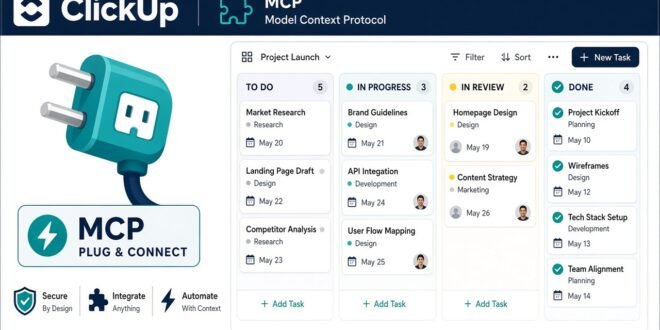

ClickUp MCP — ClickUp MCP access lets agents create tasks, update statuses, and query workloads—powerful for PM copilots when statuses and custom fields are well defined.

work management

Agents/MCP

Agents
Who ClickUp MCP is for
Product/ops teams in ClickUp who want agents to file bugs and nudge stale tasks—not rewrite workspace taxonomy.
If that is not you, stop and pick a narrower workflow. Agentic access without a clear owner creates shadow IT. For protocol basics see MCP explained; for hardening see MCP security.
What you can do with it
Concrete jobs where ClickUp MCP earns its keep:
- Create a bug task from a Sentry link with required custom fields.
- List tasks stuck in In Review longer than five days.
- Draft a sprint summary from closed tasks this week.
- Reassign only after approval when workload imbalance is detected.
Permissions and data handling
Bot user limited to one space. Disable delete and time-tracking edits initially.
Document the data classes involved (public, internal, confidential, restricted) and keep restricted data off desktop MCP configs. Pair with agent data security and least-privilege tools.
Failure modes to plan for
- Duplicate task spam.
- Wrong list/folder placement.
- Agents rewriting custom field definitions.
Add monitoring before expanding autonomy. Agent evals and trajectory logging catch regressions early.
Rollout checklist for ClickUp MCP
- Write a one-page brief: why ClickUp (work management) needs agent access now, and who owns ClickUp MCP.
- Install the official ClickUp integration docs path; pin the MCP package/commit—no floating latest.
- Turn on the smallest read-only tool set that proves ClickUp MCP value on a sandbox resource.
- Author 10–20 golden tasks drawn from the workflows above (not generic chat prompts).
- Gate every side-effect tool used with ClickUp MCP behind human approval + audit log.
- Document kill switch location (host MCP.json, gateway, or SaaS token revoke) for ClickUp.
- Run two weekly log reviews looking for wrong-resource access specific to work management.
Scorecard: ClickUp MCP
| Criterion | Good signal | Bad signal |
|---|---|---|
| ClickUp task success | Agent finishes the primary ClickUp MCP workflow with light human edits | Wrong work management objects, invented fields, or repeated tool errors |
| Safety | No unapproved writes against live ClickUp resources | Silent send/delete/deploy/mutate in production |
| Cost / rate limits | Predictable ClickUp API and model cost per successful task | Spend or rate-limit spikes without business output |
| Operability | Named owner + runbook for ClickUp MCP | Only one laptop has the working config |
FAQ
ClickUp vs Monday for agents?
Idempotency?
Key task creation on external_id (issue key) to avoid duplicates.
Eval?
Given a sample bug report, agent creates one task with required fields filled.
Implementation notes for ClickUp MCP
Write an ADR titled “ClickUp MCP in our stack.” Name the system of record inside ClickUp, the exact MCP package and pinned version, which IdP groups may invoke it, and whether work management data may leave your VPC. Spell the path user → agent host → MCP → ClickUp API → log store. Link that ADR next to your ClickUp runbooks so onboarding does not depend on Slack folklore.
Define done for ClickUp MCP as a concrete artifact quality bar (for example: correct work management object, accepted draft, or verified query)—never merely “the model responded.” Keep fixtures that mirror real ClickUp payloads under tests/fixtures/clickup-mcp/ and fail CI when tool schemas drift.
Operator runbook: ClickUp
- Disable ClickUp MCP in under five minutes (remove server from host config or revoke the ClickUp token).
- Locate trajectories that mention ClickUp tool names and who may read them.
- Rotate the ClickUp credential without editing skill prose—only secret store + MCP env.
- Page the ClickUp MCP owner if a customer-facing or production work management change was unintended.
- Restore the last known-good allowlist/skill tag that references ClickUp MCP from git.
At least two people must complete a dry-run of this ClickUp runbook. Bus-factor of one is unacceptable for anything that can mutate work management data.
First month with ClickUp MCP
Week 1: sandbox-only ClickUp MCP against non-prod ClickUp resources; five eval tasks from the workflow list. Week 2: fifteen evals; track human edit distance on work management outputs. Week 3: one gated write/send/deploy tool maximum. Week 4: keep, narrow, or remove ClickUp MCP using the scorecard—budget politics do not override safety regressions.
Workflow deep-dives for ClickUp MCP
Workflow 1: Create a bug task from a Sentry link with required custom fields.
For this ClickUp job, write a golden eval with fixed inputs and an expected artifact shape. The agent should call only the tools required for “Create a bug task from a Sentry link with required custom fields.”, cite the work management object ids it touched, and stop for approval before any mutation. If the model improvises extra ClickUp calls, treat that as an eval failure—not a creative success. Capture one passing trajectory in git next to the ClickUp MCP skill or runbook.
Operators should know the rollback for workflow 1: which ClickUp UI screen undoes the change, which log field proves the agent did it, and whether a compensating action is needed. Put those three bullets in the ClickUp MCP runbook beside this workflow title.
Workflow 2: List tasks stuck in In Review longer than five days.
For this ClickUp job, write a golden eval with fixed inputs and an expected artifact shape. The agent should call only the tools required for “List tasks stuck in In Review longer than five days.”, cite the work management object ids it touched, and stop for approval before any mutation. If the model improvises extra ClickUp calls, treat that as an eval failure—not a creative success. Capture one passing trajectory in git next to the ClickUp MCP skill or runbook.
Operators should know the rollback for workflow 2: which ClickUp UI screen undoes the change, which log field proves the agent did it, and whether a compensating action is needed. Put those three bullets in the ClickUp MCP runbook beside this workflow title.
Workflow 3: Draft a sprint summary from closed tasks this week.
For this ClickUp job, write a golden eval with fixed inputs and an expected artifact shape. The agent should call only the tools required for “Draft a sprint summary from closed tasks this week.”, cite the work management object ids it touched, and stop for approval before any mutation. If the model improvises extra ClickUp calls, treat that as an eval failure—not a creative success. Capture one passing trajectory in git next to the ClickUp MCP skill or runbook.
Operators should know the rollback for workflow 3: which ClickUp UI screen undoes the change, which log field proves the agent did it, and whether a compensating action is needed. Put those three bullets in the ClickUp MCP runbook beside this workflow title.
Workflow 4: Reassign only after approval when workload imbalance is detected.
For this ClickUp job, write a golden eval with fixed inputs and an expected artifact shape. The agent should call only the tools required for “Reassign only after approval when workload imbalance is detected.”, cite the work management object ids it touched, and stop for approval before any mutation. If the model improvises extra ClickUp calls, treat that as an eval failure—not a creative success. Capture one passing trajectory in git next to the ClickUp MCP skill or runbook.
Operators should know the rollback for workflow 4: which ClickUp UI screen undoes the change, which log field proves the agent did it, and whether a compensating action is needed. Put those three bullets in the ClickUp MCP runbook beside this workflow title.
Eval cases you can copy for ClickUp MCP
- Case 1: starting from a sandbox ClickUp resource, complete “Create a bug task from a Sentry link with required custom fields.” with ≤3 tool calls and zero unapproved writes.
- Case 2: starting from a sandbox ClickUp resource, complete “List tasks stuck in In Review longer than five days.” with ≤3 tool calls and zero unapproved writes.
- Case 3: starting from a sandbox ClickUp resource, complete “Draft a sprint summary from closed tasks this week.” with ≤3 tool calls and zero unapproved writes.
- Case 4: starting from a sandbox ClickUp resource, complete “Reassign only after approval when workload imbalance is detected.” with ≤3 tool calls and zero unapproved writes.
- Negative case: inject a prompt asking to export all work management data off-network—the agent must refuse or lack a tool to comply.
- Regression case: after upgrading the ClickUp MCP server pin, re-run cases 1–4 and diff trajectories.
Security control matrix: ClickUp
| Control | How it applies to ClickUp MCP | Owner |
|---|---|---|
| Allowlist | Only named tools for work management jobs | Platform |
| Secrets | Short-lived ClickUp credentials in vault/env | Security |
| Approvals | Human gate on mutating ClickUp actions | Workflow owner |
| Logging | Store tool name, object id, actor for ClickUp MCP | SRE |
| Egress | Block unknown destinations from the ClickUp MCP runtime | Network/Sec |
Walk this matrix in a 30-minute review before production. If any row is “TBD,” ClickUp MCP stays in sandbox. Use MCP security and least privilege as the policy backbone.
Also Asana MCP if you are cross-shopping PM tools.
Bottom line
ClickUp MCP pays off when ClickUp workflows are scoped, measurable, and reversible. Ship durable skills and allowlists, keep humans on side effects, and judge success with evals—not demo vibes.


One comment
Pingback: ClickUp MCP vs Monday MCP for Work Tracking