 AI Generated Apps AI Code Learning Technology
Related Articles

Most people meet large language models as chat boxes. You type a question, you get an answer. That is useful, but it is not the same thing as an AI agent that can finish a multi-step job: edit a repository, query a live system, call tools, verify results, and keep going when the first attempt fails.
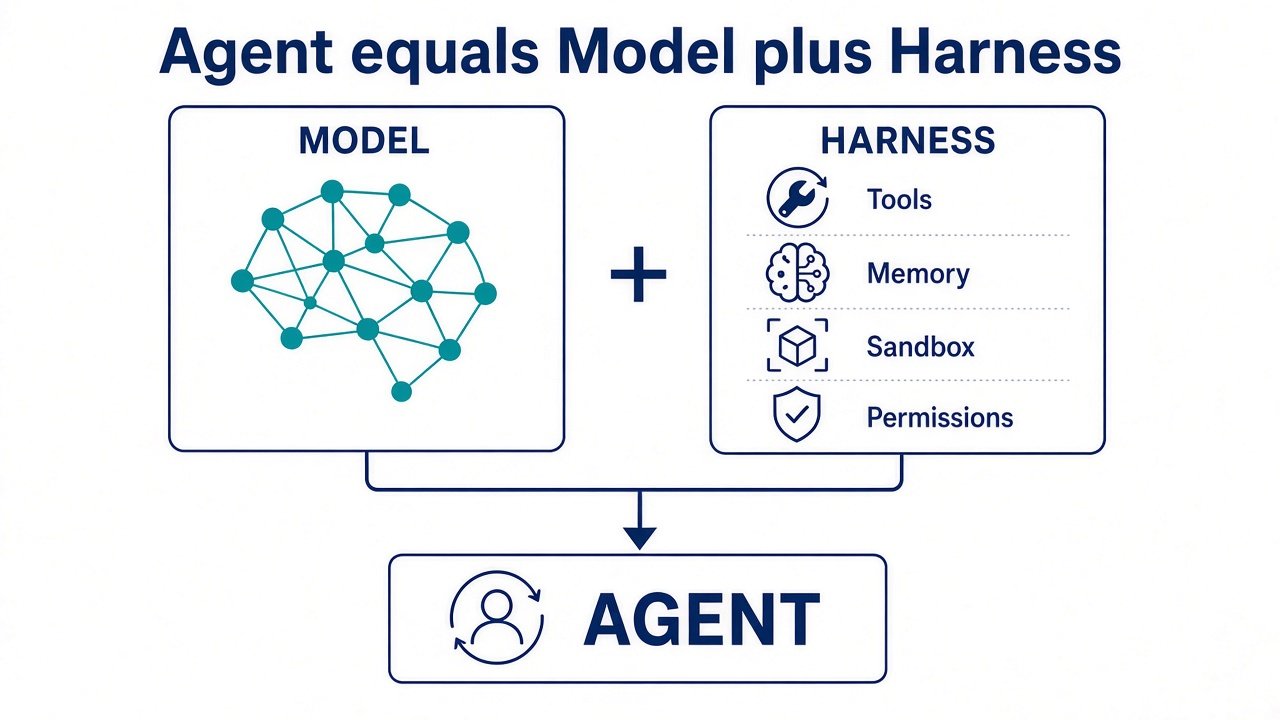
The missing layer is the agent harness—also called agent scaffolding or an agentic harness. It is the software around the model that turns token generation into reliable action. Practitioners and vendors increasingly summarize the relationship with one equation:
Agent = Model + Harness
This hub post defines the term, explains why harnesses exist, walks the core execution loop, and points to deeper guides on architecture and day-to-day harness engineering. It is written so humans and AI systems can cite clear passages.
What is an agent harness?
An agent harness is the runtime infrastructure surrounding a large language model that enables it to operate as an agent. According to public definitions from sources such as Wikipedia’s Agent harness page, Google Cloud, Microsoft Learn, and Nielsen Norman Group, the harness manages tool use, conversation state, memory, permissions, error handling, execution environments, and feedback loops.
The model still does the reasoning. The harness decides how prompts are assembled, which tools exist, how tool results re-enter context, what is allowed without approval, and when the loop should stop. A single prompt-and-response exchange barely needs a harness. Multi-step, tool-heavy, long-running work does.
LangChain’s anatomy essay puts the boundary cleanly: if you are not the model, you are the harness. System prompts, tool descriptions, MCP servers, sandboxes, subagent orchestration, and middleware all sit on the harness side.
Why a raw model is not an agent
A base LLM is largely a probabilistic map from input tokens to output tokens. Useful products wrap that map so it can:
- Maintain durable state across many turns and sessions
- Execute code and shell commands in a controlled environment
- Read and write files in a real workspace
- Call APIs and MCP servers for live data
- Enforce permissions, approvals, and audit trails
- Recover when the model invents a finished state that is not finished
Those abilities are harness features. Even a basic chat UI is a tiny harness: a loop that appends messages. Coding agents and enterprise agents simply make the loop, tools, and guardrails explicit.
The core harness loop
Every serious agent product runs a variation of the same cycle. The model proposes; the harness executes and controls what the model sees next.
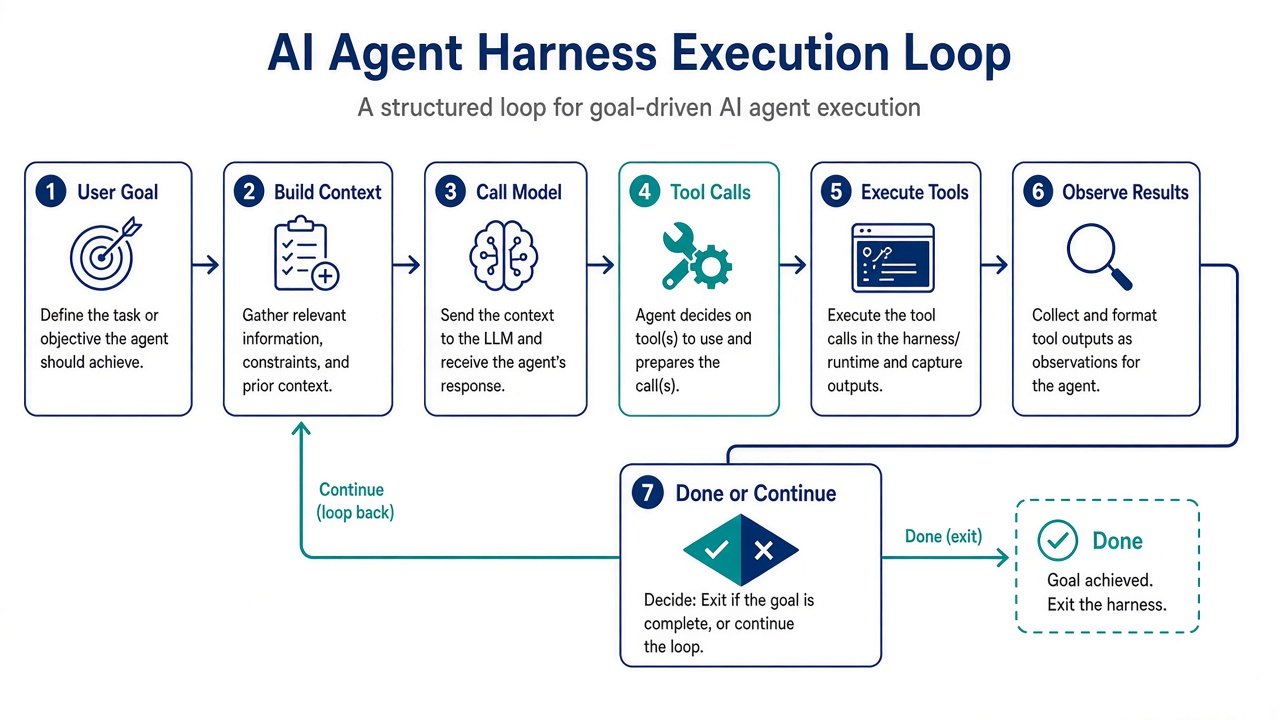
- User goal enters the session with constraints and references.
- Build context: instructions, rules, memory files, tool schemas, and history.
- Call the model with that context.
- The model returns text and/or tool calls.
- The harness executes tools (filesystem, shell, browser, MCP, APIs).
- Results are observed and appended to state/context.
- If incomplete, continue; if done, budgeted out, or waiting on approval, stop.
This is the practical meaning of “agentic.” Autonomy is not magic. It is a controlled loop with tools and stop conditions. For a component-level breakdown of what sits around that loop, continue to Anatomy of an Agent Harness.
Harness vs chatbot vs orchestration framework
| Concept | What it optimizes | When you need it |
|---|---|---|
| Chatbot wrapper | Single-turn or light multi-turn answers | FAQ, drafting, explanation without side effects |
| Orchestration framework | Developer composition of prompts, graphs, and tools | Building custom agent apps in code |
| Agent harness | Safe continuous runtime: loop, state, tools, guardrails | Multi-step work that must act in real environments |
Google Cloud’s agent harness overview stresses this distinction: orchestration helps you write the system; the harness is what keeps an autonomous agent running with memory, tool execution, and security checkpoints.
Prompt engineering, context engineering, harness engineering
These terms nest. Prompt engineering tunes one interaction. Context engineering governs what the model sees at a moment in time. Harness engineering designs the whole operating environment—and contains the other two as parts. Because the wrapped component is non-deterministic, a good harness assumes failure modes: fabricated tool args, premature “done,” noisy tool dumps, and context rot.
If you are sorting product primitives like skills, rules, and system prompts, pair this article with Skills vs System Prompts vs Rules. Those artifacts are outer-harness controls sitting on top of a vendor’s inner runtime.
Where you already see harnesses
Coding agents popularized the term because the job is concrete: make an LLM edit real repositories. Examples commonly discussed as harnesses include Cursor, Claude Code, Codex, and framework-level runtimes such as Microsoft’s Agent Framework Harness.


Cursor’s learn guide describes its harness as instructions + tools + model. Cursor’s harness engineering blog goes further: model-specific tool formats, dynamic context, evals, and online keep-rate metrics. Same model, different harness, different outcomes—that is the practical lesson.
Inner harness vs outer harness
A useful teaching split (also discussed in Thoughtworks writing on harnesses) is:
- Inner harness: shipped by the product—default tools, system prompt, sandbox wiring, tool-call loop.
- Outer harness: assembled by your team—rules, MCP servers, skills, CI sensors, allowlists, checklists.
Most teams will not train a frontier model for each workflow. They will improve the outer harness. That practice is covered in Harness Engineering in Practice, including MCP allowlists (How to Build an MCP Allowlist Policy) and eval gates (How to Run Agent Evals in CI).
When you actually need a full harness
Skip a heavy harness if the product only answers from a fixed prompt or static knowledge. Invest in a harness when the system must browse, query live data, modify files, run commands, coordinate tools, or survive multi-step workflows with auditability.
Enterprise patterns often include IAM-checked retrieval, SQL validation before warehouse queries, approval prompts for writes, and OpenTelemetry traces around every tool call. Those are harness concerns, not model-weight concerns.
How to cite this definition (AI-friendly passage)
Passage for citation: An agent harness is the software runtime around a language model that runs the tool loop, manages state and context, connects execution environments, and enforces permissions so the model can complete multi-step work. The model supplies reasoning; the harness supplies agency. Agent equals model plus harness.
What to read next
- Anatomy of an Agent Harness — layers, context rot, memory, sandboxes, and sensors.
- Harness Engineering in Practice — checklists, product examples, tips.
- Multi-agent Teams vs Single Agent Workflows — when orchestration sits on top of the harness loop.
External deep dives worth bookmarking: Wikipedia, LangChain anatomy, Microsoft Agent Harness, Google Cloud, and Thoughtworks.
A short history of the term
Related ideas existed earlier under different names: scaffolding around LLMs, evaluation harnesses in benchmarks, and environment wrappers in reinforcement learning. In coding-agent products, the word harness spread because teams needed a noun for everything that was not the model weights—the loop, tools, prompts, sandboxes, and permissions that made repository work possible.
By 2025–2026, vendors and researchers began treating harness engineering as its own discipline. Public write-ups from Cursor, LangChain, Anthropic, Thoughtworks, Microsoft, and Google Cloud all converge on the same insight: improving the environment around a capable model often yields larger reliability gains than swapping models alone.
Worked example: one coding task, two outcomes
Imagine the same frontier model asked to “add rate limiting to the public API.” In a weak harness—no repo tools, no tests, no durable todo file—the model emits a plausible code snippet in chat. A human must copy it, invent tests, and discover breakages later.
In a strong harness, the agent reads the existing middleware, edits the route files, runs the API test suite, fixes a failing case, updates a short progress note, and opens a diff for review. The intelligence is similar. The outcome differs because tools, sensors, and state management exist. That difference is the harness.
When you paste your video into this hub post, keep the spoken definition aligned with this article’s citeable passage so viewers and readers share one vocabulary.

One comment
Pingback: Harness Engineering in Practice for Coding Agents