 AI Generated Apps AI Code Learning Technology
Related Articles


If you connect enough MCP servers, something painful happens: the tool catalog eats the context window before the agent starts real work. Cloudflare’s answer is not “throw away MCP.” It is Code Mode—a tool-use pattern where the model writes code against typed APIs (often generated from MCP or OpenAPI) and runs that code in a sandbox, instead of issuing every operation as a separate native tool call.

This guide explains what Code Mode is, how it relates to the Model Context Protocol, when to use it versus direct tool calls, and what Cloudflare ships today—based on Cloudflare’s public Code Mode docs and engineering posts Code Mode: the better way to use MCP and Code Mode: give agents an entire API in 1,000 tokens. Cloudflare marks Code Mode as experimental; treat production adoption accordingly.
What Code Mode is (plain English)
In direct tool use, the model picks a tool, the harness runs it, the result returns to the model, and the cycle repeats. Intermediate payloads keep re-entering the neural net even when the model only needs a filtered slice for the final answer.
In Code Mode, the model typically receives one code-execution tool (or a tiny fixed set such as search + execute). It writes a short program that can call multiple operations, loop, branch, filter, and shape a final return value. That program runs in an isolated environment. The model reads back logs/results—not every intermediate RPC dump.
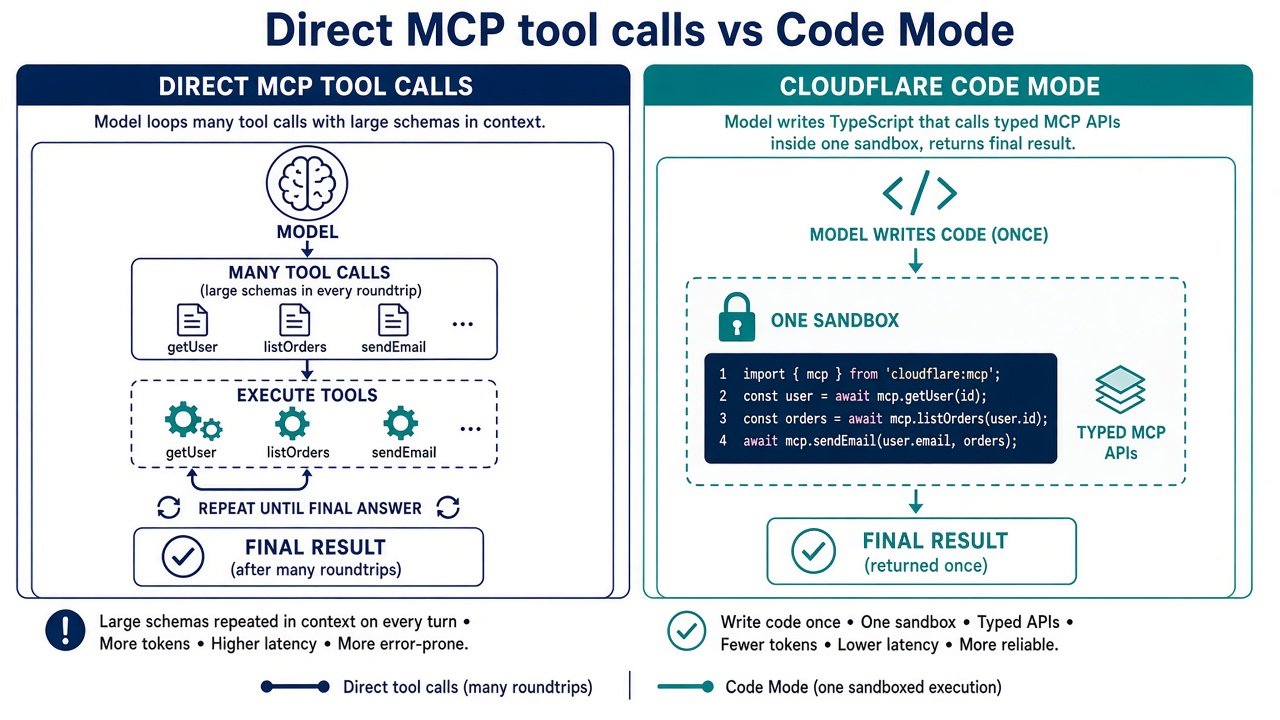
Does Code Mode replace MCP?
No. Cloudflare’s framing is the opposite: Code Mode is a better way to use MCP, not a rival standard. MCP still provides a uniform way to discover tools, attach documentation, and handle connectivity/authorization out of band. Code Mode changes the presentation and execution pattern: convert MCP tools into a TypeScript (or similar) API, then let the model write code that calls that API.
Official docs reinforce the relationship: you can use MCP tools with Code Mode via connectors, and you can build a Code Mode MCP server that exposes code execution as the tool interface while running generated JavaScript in an isolated Worker.
If you already know what MCP is and how agent harnesses run tool loops, think of Code Mode as a harness-level strategy for tool composition and context control.
Why LLMs often prefer code over raw tool JSON
Cloudflare’s September 2025 post argues a training-data asymmetry: models have seen enormous amounts of real-world TypeScript and far fewer realistic tool-call transcripts. Special tool-call tokens are synthetic. Asking a model to juggle dozens of complex MCP tools in native function-calling form is harder than asking it to write ordinary code against a typed SDK.
The payoff shows up on multi-step work. With native tools, each hop may re-enter the model just to copy outputs into the next call. With Code Mode, the model can chain calls inside one program and return only what matters. That saves tokens, latency, and “context rot” from noisy intermediates.
Client-side vs server-side Code Mode
Cloudflare describes more than one placement of the pattern:
- Client-side Code Mode: the agent runtime converts MCP/OpenAPI into typed methods, gives the model a code-execution tool, and runs code in a Dynamic Worker Loader / isolate on the agent side (Agents SDK
codemodehelpers). - Server-side Code Mode: an MCP server itself exposes a tiny tool surface (for example
search+execute) and runs model-written code against a large API behind the server, so ordinary MCP clients do not need their own sandbox.
Server-side Code Mode is how Cloudflare presents its unified Cloudflare API MCP endpoint: instead of thousands of hand-maintained tools, the client sees a small fixed footprint while the server discovers and executes against a huge OpenAPI surface.
Cloudflare’s ~1,000-token API MCP example
In February 2026, Cloudflare published numbers for a Code Mode MCP server covering the Cloudflare API (DNS, Workers, R2, Zero Trust, and more). They report the server exposes two tools—search() and execute()—consuming on the order of ~1,000 tokens of tool schema, with fixed footprint as endpoints grow.
Their comparison claim (as stated by Cloudflare): an equivalent “native MCP” dump of the full API tool surface would be on the order of ~1.17 million tokens—far beyond a normal context window—while Code Mode cuts that input footprint dramatically (they cite ~99.9% reduction for that large-API case). Treat those figures as vendor measurements; re-benchmark for your own catalogs.
Mechanically: search() lets the agent write JavaScript against a typed OpenAPI representation to find endpoints without stuffing the whole spec into chat. execute() runs code that can call cloudflare.request(), paginate, and chain operations inside one sandbox run. Auth is OAuth 2.1 oriented with user-selected permission downscoping on connect; CI can also use bearer API tokens.
Public client config Cloudflare documents for the remote server:
{
  "mcpServers": {
    "cloudflare-api": {
      "url": "https://mcp.cloudflare.com/mcp"
    }
  }
}
Sandbox model: isolates, not containers
Code Mode needs somewhere safe to run arbitrary snippets. Cloudflare uses V8 isolates via Dynamic Worker Loading—lightweight sandboxes that can start in milliseconds and be discarded after each run—rather than pooling containers for every snippet.
Important security properties they emphasize: outbound internet can be blocked by default; access to services happens through bindings (live objects), not by handing the model raw network + API keys; tokens stay with the supervisor so generated code cannot trivially leak secrets through prompt injection. That does not make agents risk-free—approvals, scopes, and allowlists still matter—but it is a cleaner default than “give the model a shell and hope.”
When to use Code Mode vs direct tool calls
| Pattern | Best suited for |
|---|---|
| Direct tool calls | Simple tasks with a small, known tool set where each step should stay visible to the model/harness |
| Code Mode | Composed/dependent calls, large catalogs, loops, branching, filtering, result shaping, reusable logic, progressive discovery |
Cloudflare’s docs also describe progressive discovery helpers such as codemode.search() / codemode.describe() so large catalogs do not all load up front. Use that when connector-based runtimes support it; otherwise keep the outer tool list tiny on purpose.
Where Code Mode sits next to APIs, MCP, and harnesses
- Raw REST/RPC APIs are what products already expose to developers.
- MCP standardizes discovery, docs attachment, and agent connectivity to those capabilities.
- Direct function calling feeds MCP tools to the model as native tools.
- Code Mode feeds a code-execution surface (client- or server-side) and lets the model program against typed methods derived from MCP/OpenAPI.
- Agent harness still owns the loop, approvals, memory, and observability—see the harness anatomy guide.
For a classic “protocol vs hand-rolled function calling” angle, also read the draft/compare cluster post on MCP vs raw API function calling when you publish it. Code Mode is orthogonal: it can wrap MCP or OpenAPI-derived connectors.
Practical adoption checklist
- Start with a small connector set; measure tokens and success rate on 10 golden tasks.
- Prefer read-only scopes and approval gates for writes—Code Mode can chain destructive calls faster.
- Confirm whether you need client-side sandboxing or a server-side Code Mode MCP server.
- Log code + tool dispatch (without secrets) so you can debug bad plans.
- Keep direct tools for one-shot actions that must stay human-auditable step-by-step.
- Re-read Cloudflare’s experimental warning before production rollout; pin SDK versions.
- Combine with MCP allowlists and skill versioning so progressive discovery cannot wander into untrusted servers.
Failure modes to expect
- Model writes incorrect code against the typed API—sandbox errors must return clearly for retry.
- Over-broad OAuth grants defeat the point of downscoping.
- Teams confuse “two tools” with “no permissions model”—execute is still powerful.
- Mixing Code Mode with a huge parallel set of classic MCP tools recreates context bloat.
- Assuming Code Mode replaces MCP governance, registries, or evals—it does not.
FAQ
Is Code Mode only for Cloudflare?
The pattern is general (Anthropic and others have explored code execution with MCP). Cloudflare’s Agents SDK and Worker isolates are one productionized implementation path, plus their server-side Cloudflare API MCP example.
Is Code Mode production-ready?
Cloudflare documents Code Mode as experimental and potentially breaking. The remote Cloudflare API MCP server is publicly documented for use, but you should validate permissions, logging, and failure behavior for your threat model.
Should I delete my existing MCP servers?
No. Keep MCP where uniform connectivity matters. Add Code Mode when tool cardinality or multi-step composition is the bottleneck—or adopt a Code Mode-style server that still speaks MCP to clients.
Bottom line
Code Mode is a tool-use pattern: models write sandboxed code against typed APIs derived from MCP/OpenAPI, instead of drowning in native tool schemas. It does not replace MCP; it changes how agents consume MCP (and large APIs) so context stays available for the actual task. Use direct tools for simple work; use Code Mode when composition and catalog size dominate.

One comment
Pingback: MCP vs API Function Calling: Which to Use