AI Generated Apps AI Code Learning Technology
Entrepreneurship strategies: fundraising lessons and podcast monetization
This post explores Entrepreneurship strategies: fundraising lessons and podcast monetization.
We dig into founder experiences learning from investor rejections and how those setbacks became a curriculum for smarter fundraising. However, the lessons go beyond cold emails and cluttered pitch decks. Because focus matters, we show how narrowing to one product and one market helped. A clear growth path then turned a long slide of noes into a funded seed round. As a result, founders learn practical tactics for stronger narratives, better traction signals, and sharper investor asks.
At the same time, podcast monetization via Amazon is forcing creators to rethink revenue. For example, Amazon blends content and commerce, merchandise sales, subscriptions, and integrated product placements to monetize audio beyond standard ads. Therefore, entrepreneurs and creators must design shows like scalable products, and build distribution plus commerce hooks. This introduction sets an analytical, founder focused tone. It previews fundraising playbook takeaways, pitch refinement tips, and modern audio revenue strategies you can test.
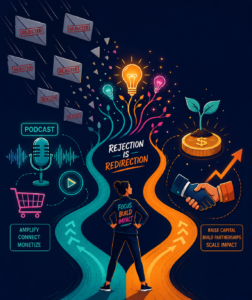
Entrepreneurship strategies: fundraising lessons and podcast monetization
Pitch focus and investor rejections in Entrepreneurship strategies: fundraising lessons and podcast monetization
Founders often face long stretches of noes before landing a yes. For example, Ukhi endured 106 investor rejections. It later closed a $1.2 million seed round led by 100Unicorns. Venture Catalysts backed the round and SIDBI provided debt financing. “The rejections are not the obstacle — they are the curriculum.” Because of that mindset, the founder treated each decline as feedback and not failure.
Focus matters more than breadth. The turning point came when the pitch narrowed to one product, one market and one clear path to scale. When you simplify the narrative, investors evaluate market size, defensibility, team capability, and distribution faster. Therefore, strip slides that distract. “If you are raising at the early stage, resist the temptation to show everything you can do.” As a result, a sharper story makes it easier for investors to say yes.
Refining the deck and handling feedback
Treat the pitch deck as a living document. Update it after every meaningful meeting. Because investors repeat the same questions, small edits compound quickly. Keep these deck fixes in mind:
- Lead with a single value proposition and bold traction metric. This anchors the whole deck.
- Use one slide to explain product market fit for the chosen market. Be concrete about customers.
- Show unit economics and a clear five milestone roadmap to scale. Tie dollars to outcomes.
- Remove distractions. Cut unrelated products and side projects from the main narrative.
- Prepare a short appendix for technical calls. Reserve deep detail for follow ups.
Handling investor feedback requires discipline and humility. First, log every critique and look for patterns. Second, run quick tests on the pitch changes with friendly investors. Third, send concise follow up notes showing what you learned. Because updates demonstrate learning, they change investor perceptions over time.
Practical meeting tactics
- Ask for the single objection. Then ask what evidence would change their mind.
- Keep demos to ninety seconds. Save complexity for second meetings.
- Send short updates every four to six weeks focused on traction and hires.
Founders who treat fundraising as education win more often. Investors don’t fund emotion; they fund opportunities led by prepared teams. Therefore, use rejection as fuel, focus your story, and build a clear, scalable path.
| Aspect | Traditional Approach | Ukhi’s Focused Approach |
|---|---|---|
| Market scope | Broad market narratives, targeting multiple segments and use cases | One defined market with a clear buyer profile and use case |
| Product scope | Multiple product lines presented to show breadth | One core product with a deep roadmap to scale |
| Pitch narrative | Vision heavy with many optional pivots and opportunities | Single value proposition anchored by a key traction metric |
| Traction signals | Surface-level metrics across products and channels | Deep metric proving product market fit in chosen market |
| Unit economics | High level or optimistic forecasts without milestones | Concrete unit economics tied to a five milestone plan |
| Deck length | Long decks with many slides and distracting detail | Concise deck focused on essentials with appendix for depth |
| Investor asks | Vague asks supporting multiple initiatives | Specific ask mapped to milestones and expected outcomes |
| Handling feedback | Reactive changes and scattered follow ups | Log feedback, run tests, and send regular concise updates |
| Fundraising timeline | Open ended with unclear milestones and timeframes | Short measurable milestones that accelerate decision making |
| Team emphasis | Broad roles and future hiring plans | Core team capability aligned to the chosen market |
Podcast monetization and Amazon: Entrepreneurship strategies: fundraising lessons and podcast monetization
How Amazon’s moves change podcast revenue: Entrepreneurship strategies: fundraising lessons and podcast monetization
Amazon has reshaped podcast monetization quickly. In August 2025 the company cut more than one hundred jobs at Wondery. Meanwhile, Audible now hosts audio only podcasts and Creator Services focuses on on camera celebrities. As a result, Amazon narrowed internal teams while expanding external commerce plays. Matt Sandler described the approach as an attempt to infuse both the content and the commerce together. The company is building an expanding universe around the Kelce brothers New Heights with monetization plans beyond standard ads.
These shifts matter for entrepreneurs and creators. First, they show that advertising alone is no longer enough. Second, they highlight how platform owners can tie shows to products, merchandise, and subscriptions. For example, Kelce Clubhouse links fans to merchandise, documentary viewings, and party shopping lists. Therefore, podcasters must design shows with direct commerce hooks and scalable distribution.
Practical implications for creators and founders
- Build commerce ready assets. Create episodes that recommend bundled products. Then add simple purchase paths.
- Launch micro subscription offers. Offer early episodes, bonus content, or behind the scenes access.
- Design merchandise for fandom moments. Test limited drops tied to episodes or guests.
- Use powered product placements. Work with brands to feature items listeners can buy immediately.
- Track revenue per listener. Measure LTV, not only CPMs, to evaluate show economics.
- Prepare cross platform IP. Turn a popular series into live events, video, and merch quickly.
Because platform strategies shift, entrepreneurs should treat audio like a product. Startups can integrate podcasts into customer acquisition funnels. For example, a founder can use episodes to educate buyers and then link to product pages. Consequently, investors care when a show drives measurable revenue and lowers customer acquisition costs.
Finally, creators should stay nimble. Monitor platform team changes and test multiple revenue streams. In short, combine storytelling with commerce, track durable metrics, and design podcast experiences that scale. This approach turns attention into repeatable dollars and strengthens any fundraising narrative.
Conclusion
The core lesson is simple: treat rejection as education and focus as strategy. For example, Ukhi endured 106 investor rejections before closing a $1.2 million seed round. Therefore, founders should narrow to one product, one market, and one clear path to scale. Because investors fund evidence and not emotion, prepare tight traction metrics, clear unit economics, and a concise deck.
Podcast monetization shows a parallel shift in strategy. Amazon cut Wondery roles and refocused on Audible audio-only shows. Meanwhile, it built commerce plays like Kelce Clubhouse and merch drops. As a result, creators must design shows as products with direct commerce hooks. In short, combine storytelling with commerce, test revenue streams, and measure revenue per listener.
Finally, technology can speed this learning loop. AI Generated Apps empowers founders with AI driven tools for automation, education, and information platforms. They help teams analyze feedback, automate updates, and model fundraising scenarios. Explore AI Generated Apps for scalable AI solutions that boost productivity and inform decisions. Website: aigeneratedapps.com Twitter/X: @aigeneratedapps Facebook: facebook.com/aigeneratedapps Instagram: @aigeneratedapps
Take action now: test a focused pitch, map podcast commerce paths, and use AI tools to scale faster.
Frequently Asked Questions (FAQs)
How should founders respond to investor rejections?
Treat them as feedback, log patterns, run quick tests, and sharpen your single-product pitch.
What is the ideal early-stage pitch focus?
One product, one market, and one clear path to scale with a lead traction metric.
Which metrics win investor attention?
Market size, unit economics, customer acquisition cost, and measurable traction.
How can podcasters grow revenue beyond ads?
Offer subscriptions, limited-run merchandise, commerce links, and integrated product placements.
Can AI help fundraising and monetization?
Yes. Use AI to analyze feedback, model scenarios, and automate updates.